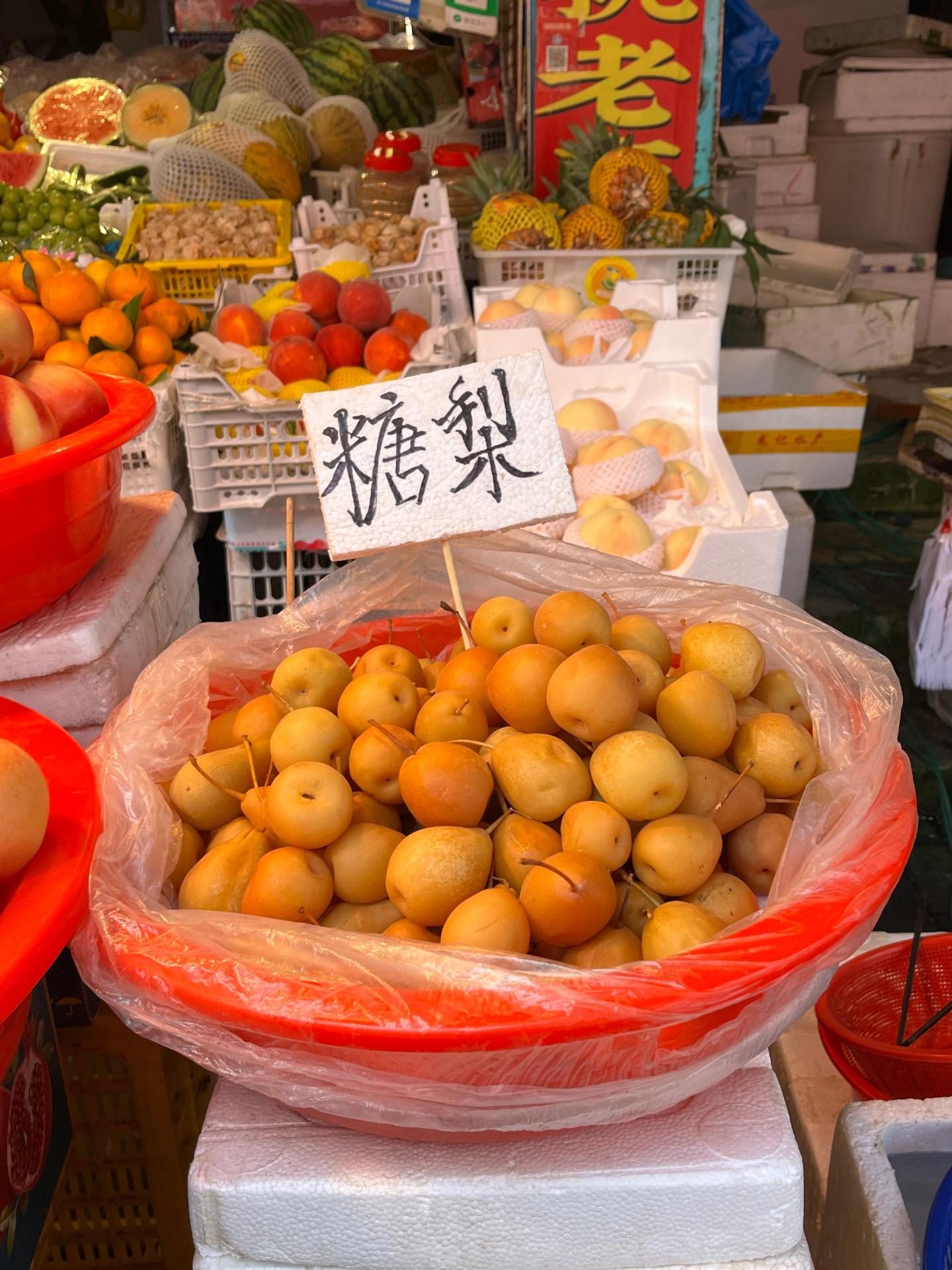
As an afternoon treat, my mother tossed a heavy plastic bag filled with ‘Tang Li’ onto the dining table.
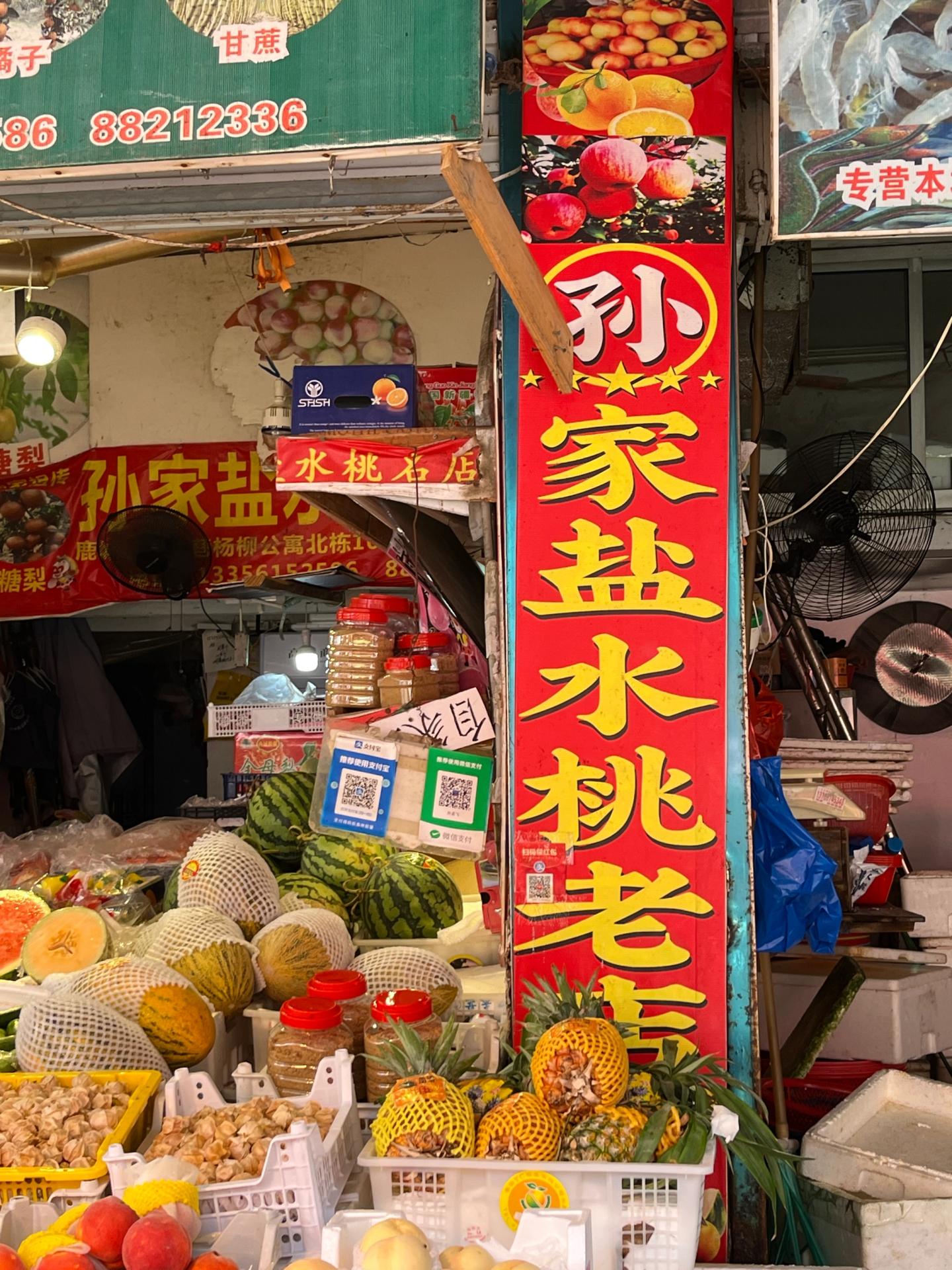
Literally translated as ‘sugar pear,’ I’d begged her to buy them several days ago when we were together at the market in Wenzhou City. They looked like something between loquats and mini Chinese pears; round and chubby, almost the size of a kid’s fist. The scarlet sign of their stall read‘Family Sun’s Old Brine-Peach Shop’, with their family name proudly stamped with five golden stars. Inside, their little fruits glowed with a soft amber sheen.
“Mom! What are these? Can we get some?”
The word “brine” printed on the shop sign; the hand-brushed “sugar” on the product name tag with an old-world calligraphic grace; my imagination of the pear’s crisp freshness… All these began to mingle and creep across my tongue.
I smacked my lips unconsciously.
They must have been steeped in honey to look so lovely.
Rallied by my mother’s call, the family gathered around the table, some curious, some sceptical. Surprisingly, they seemed to be a novelty in our hometown, even though Wenzhou City was only a few score of miles away.
I picked one up. The moment my teeth carved a shallow arc into its skin, a wave of theatrical exclamations erupted around me whose meaning was too hard to grasp. Their reactions were complicated, like a mixture of shock, confusion, and dislike; yet it was hard for me to believe that the pears could taste that bad.
I bit down.
"Sugar pear”… Sugar? I thought it would taste like sugar. Yet instead surging salty waves crashed through my mouth, accompanied by the chilling storm of licorice reacting in my head. But sugar? There was none.
I spat the whole chunk out without chewing and stared at it, bewildered.
“Oh, sugar pears. You got them from Wenzhou, didn’t you?” My grandmother said as she staggered to the table, having been awakened from her nap by our clamour. Nearly ninety now, she still carried a boundless curiosity to participate in every little thing happening in the house. She spoke serenely as she opened the bag, like someone greeting her long-lost love with practiced composure.
My grandmother had once told me that in her time, when the shoal by the village had not yet been filled as farmland, no railway reached here. To travel afar, one had to endure long, weary journeys to the commercial port of Wenzhou City, the very same place where we had bought the sugar pears earlier that week. There she would wait, clutching her luggage and surrounded by her young children, waiting for the westbound train that would reunite her with my grandfather, a thousand miles away.
I could barely believe that she had managed this dozens of times. Nor could I picture her first encounter with sugar pears in those days, or the taste they carried back then.
According to the Chinese online encyclopedia, ‘Tang Li’ refers to a traditional thirst-quenching fruit snack mainly produced in the Chaoshan[1] region of southern China. It is made from birchleaf pear, a type of tiny pear no bigger than a ping-pong ball with thick and rust-colored skin. Though for us they are sour and astringent when eaten raw, they’re beloved by birds, earning them mocking nicknames “bird pears” or “dog-shit pears”.[2] However, when boiled, brined, and soaked in licorice, they are transformed into a savoury luxury in times of scarcity.
The sugar pears in Wenzhou, whose skin is paper-thin with firm flesh, are probably made from a different variety as those of Chaoshan. Some claim they are made from the wild pears of the nearby mountains. Their method of preparation, however, seems almost identical.
It makes me wonder if sugar pears were originally a “good from the South,” a term from my grandmother’s time when Southern trade boomed. Though less used today, it gives the essense of a delicacy only found in trading ports. After all, in my hometown of Yueqing in the mountainous outskirts of Wenzhou City, few people had ever heard of sugar pears. Maybe the bustling markets and sweltering heat of Wenzhou City meant these thirst-quenching pears lingered on the palates of the adventurous Chaoshan merchants when they came north. Or perhaps someone from Wenzhou once encountered the recipe during a southbound trip and brought it back with them. Who knows? It seemed no one had any explanation for this shared sugar-pear practice. All those who I’ve spoken to can recall is that, decades ago, sugar pears were piled high in basins, conquering every corner of the city.
Today, it seems that sugar pear has long fallen out of fashion. One may find it only in a few of Wenzhou’s old-fashioned farmers markets, or in certain restaurants featuring Wenzhou specialities that target tourists. You can also find grumbles online from some locals that the last sugar pears in town are terrible, never tasting as they once did.
On these grumbles, curious people left comments asking what sugar pears taste like. Some said salty; others said sweet and sour. A few likened it to preserved plums; others called it “a flavor for old people.” Others still felt nostalgia; or confessed that a single bite was enough to make them recoil.
So what does sugar pear really taste like?
“How could such a thing even exist?” My grandmother’s two grown-up children exclaimed in disgust. My mother, ever proud of her thrift, took a few hasty, reluctant bites and threw the rest away. Amid the chaos, the family scattered, as quickly as they had gathered by the sugar pear.
My grandmother sat there, taking her time eating, nodding with quiet contemplation. Once she’d finished one, she grabbed another.
Whatever sugar pear really tastes like; for my grandmother it must be the taste of Wenzhou as it once had been.
I looked at the chunk of pear in my hand, and put it back into my mouth, determined to finish it this time.
This article is a contribution from one of the participants of The Gramounce Food & Art Alternative MA 2025-27. Their writing is inspired by one of our seminars, or responds to a similar field of interest within food & art.
_______
[1] Chaoshan, or Teoswa (潮汕 in Chinese), is a cultural-linguistic region in eastern Guangdong, China. Since the late Tang Dynasty, it has been renowned for the Chaoshang (潮商 in Chinese), namely merchant communities from this region who traveled north within China and south to Southeast Asia.
[2] Baidu Baike (2025) 鸟梨. Available at: https://baike.baidu.com/item/%E9%B8%9F%E6%A2%A8/10442965 (https://baike.baidu.com/item/%E9%B8%9F%E6%A2%A8/10442965) (Accessed: 31 October 2025).
Ziyi Lian is a researcher, social designer, and writer moving between China and the Netherlands. Trained in Social Design at Design Academy Eindhoven, her practice drifts across food, space, community, and the textures of everyday life. She observes, chews on what she encounters, spits it out, and slips back into the crowd. She is also the co-initiator of To Be Cooked, a design collective exploring food as a medium of connection.