I
The elders always say that names matter, because they determine other’s first impression of you.
And the Chinese olive—called the ‘sweet olive’ in Wenzhou City—is no exception.
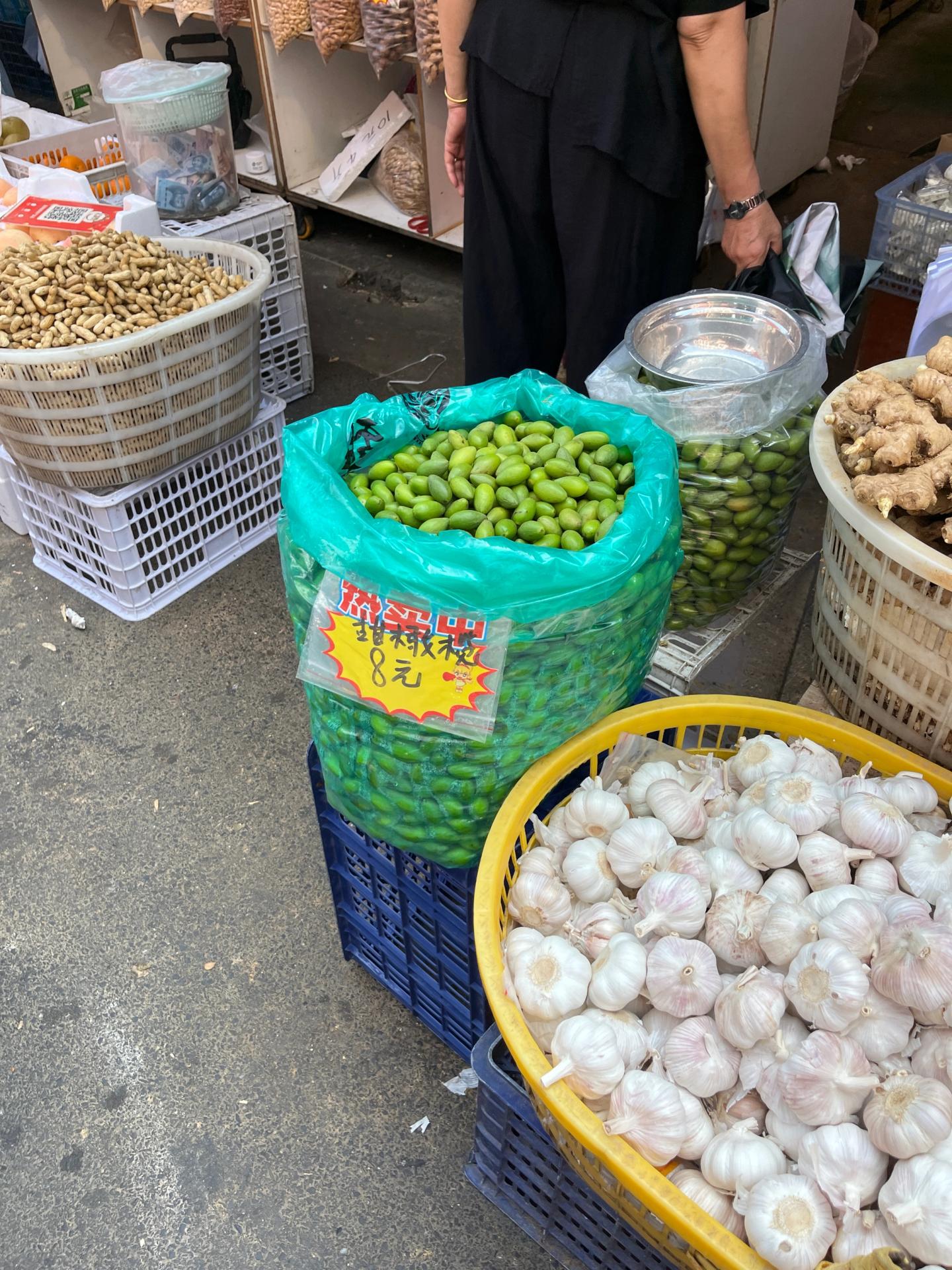
Despite sharing the name “olive,” it has nothing to do with the European olive. Native to southern China, it is recorded in ‘Lingbiao Luyi’[1], a book dating from the Tang dynasty (7th to 10th century CE). It is elegant in appearance: vibrant green all over, the size of a child’s thumb, and shaped like a tiny rugby ball. No wonder the sport is literally called “olive ball” in Chinese.
In summer markets, vendors pile them into waist-high green plastic bags. Under the sharp sunlight, a thin mist appears on the bag’s inside walls, as the little fruits jostle and squeeze against one another, looking lively, if almost a bit petulant.
They are so adorable that one feels an urge to rescue them immediately, almost forgetting that first impressions are often the most deceptive.
II
I love fantasising. To me, the moment before the first bite of any curious food is when it tastes the best. It’s like New Year's countdown in December, the night before a trip while packing your suitcase, the impatient foot-tapping in a downward elevator when craving a cigarette. It is the soft, romantic, safe space of infinite possibility, fuelled by the anticipation of something that is about to arrive. All my desires are projected onto that moment, right up to the instant in which my tongue touches the food, and my personal eating experience is updated.
Refreshing, sweet, surprising in a pleasant way.
That was my final fantasy of the sweet olive before the reality of its taste touched my tongue. Unfortunately, I was to soon find out that the charm of a curious food, or of desire itself, lies mostly in its unresolved potential. I was too hasty in trying to satisfy my desire, and my fantasy ended in hard reality.
III
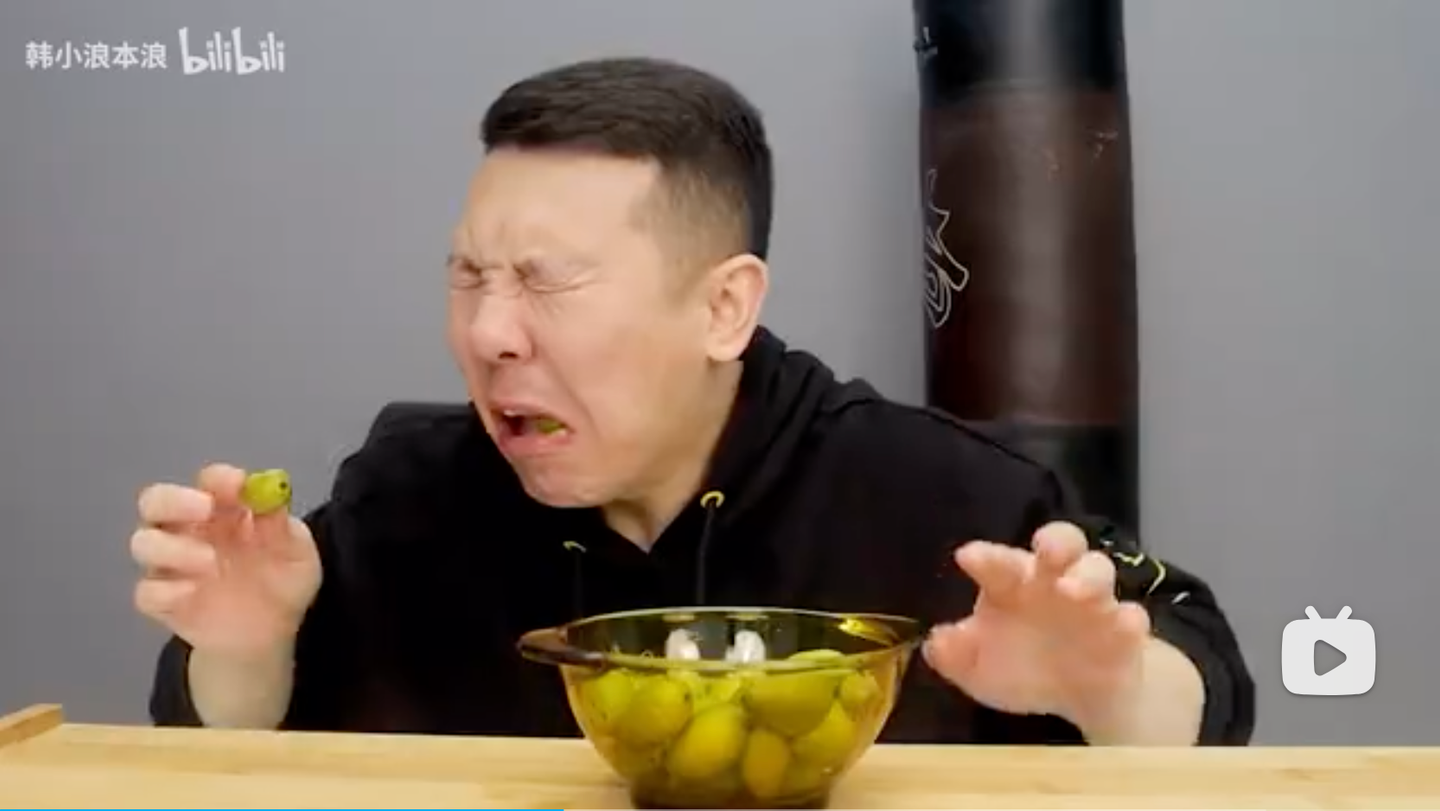
If there were ever a food designed to scrunch up one’s face, it is the Chinese olive. Chewing it feels like taking a bite of sauerkraut and tea leaves at the same time, and my face puckered up like a dried salted plum in a jar. Later, curious if it was just me, I checked a number of food vlogs, of which even the adventurous ones shared my reaction.
“Is it sweet?” My uncle, newly involved in this olive situation, asked my grandmother cautiously. As a respected elder, she wasn’t supposed to lie.
“Try it yourself,” my grandmother said, her amber-colored eyes swirling with mischief. She brought one of the fruits up close to her lips, but didn’t bite down. I was already searching for something to reset my palate, but paused to observe my uncle instead.
He took the bait and, of course, the green pebble puckered his face too, triggering bursts of laughter from my grandmother.
I didn’t know whether she really liked the bitter taste of the Chinese olive, but with this joke she certainly made the situation sweeter.
IV
During this whole time, my mother kept smacking her lips. “Huh? There is a bit of sweetness,” she said, her face softening. I couldn’t understand how she genuinely derived pleasure from contemplating its flavour, as if she knew that waiting would guarantee a result, sooner or later.
“Aftertaste. It really is sweet.” I couldn’t say she was lying.
Only later did I learn that the Chinese term ‘hui gan’, literally translated as ‘returning sweetness,’ was originally coined to describe the Chinese olive. It refers to a sweet aftertaste that emerges only after the bitterness fades. By the time it happens, there’s nothing left to chew in your mouth. And the perception originates not from the tip of the tongue, but from the throat, which has fewer taste buds and is usually considered an emotionless swallowing corridor.
‘Hui gan’ is a brief interval; a moment of complete mindfulness while waiting, which the eater exchanges for with how they taste it, and their perception of this taste.
V
Ancient Chinese literati, especially court officials and poets, loved this kind of detour into subtlety. In his poem, “Olive,” Northern Song poet Wang Yucheng compared this delayed sweetness to the honest remonstration of a loyal minister to the emperor. “Only after a long while does one find it sweet as malt sugar.”[2] Thus, the olive earned the nicknames “remonstration fruit” and “loyal fruit.”
It’s also said that, when paired with fine black tea—or ‘Bohea’—the sweet aftertaste of both is amplified, leading to a moment of sudden clarity. Perhaps the Chinese olive finds straightforward sweetness too easy, too flattering, and chooses instead to hide it in time, waiting to be discovered. But without a certain level of composure, attention, and patience, how could one endure such an astringent yet empty taste?
For someone like me, the “sweet olive” should probably be sued for false advertising.
_______
Frozen Chinese Olive Recipe
500 g green Chinese olives,
1 tbsp salt,
100–150 g sugar
This method removes the astringency as much as possible. Perfect for someone like me, who is not very good at waiting and savouring.
This article is a contribution from one of the participants of The Gramounce Food & Art Alternative MA 2025-27. Their writing is inspired by one of our seminars, or responds to a similar field of interest within food & art.
_______
[1] ‘Lingbiao Luyi’ (岭表录异 in Chinese), literally translated as ‘Records of the Strange from South of the Ridges’ was a miscellanea written by Liu Xun (刘恂 in Chinese), documenting the products, customs, climate, and curiosities of Lingnan region, namely Guangdong, Guangxi and Hainan province today. It includes descriptions of plants and animals, cooking methods, and agricultural techniques like fish farming in rice paddies and using ants to control pests.
[2] This sentence is translated by the writer into English. Original source: 橄榄 (n.d.) Wikisource. Available at: https://zh.wikisource.org/zh-hans/%E6%A9%84%E6%AC%96 (Accessed: 30 November 2025).
Ziyi Lian is a researcher, social designer, and writer moving between China and the Netherlands. Trained in Social Design at Design Academy Eindhoven, her practice drifts across food, space, community, and the textures of everyday life. She observes, chews on what she encounters, spits it out, and slips back into the crowd. She is also the co-initiator of To Be Cooked, a design collective exploring food as a medium of connection.