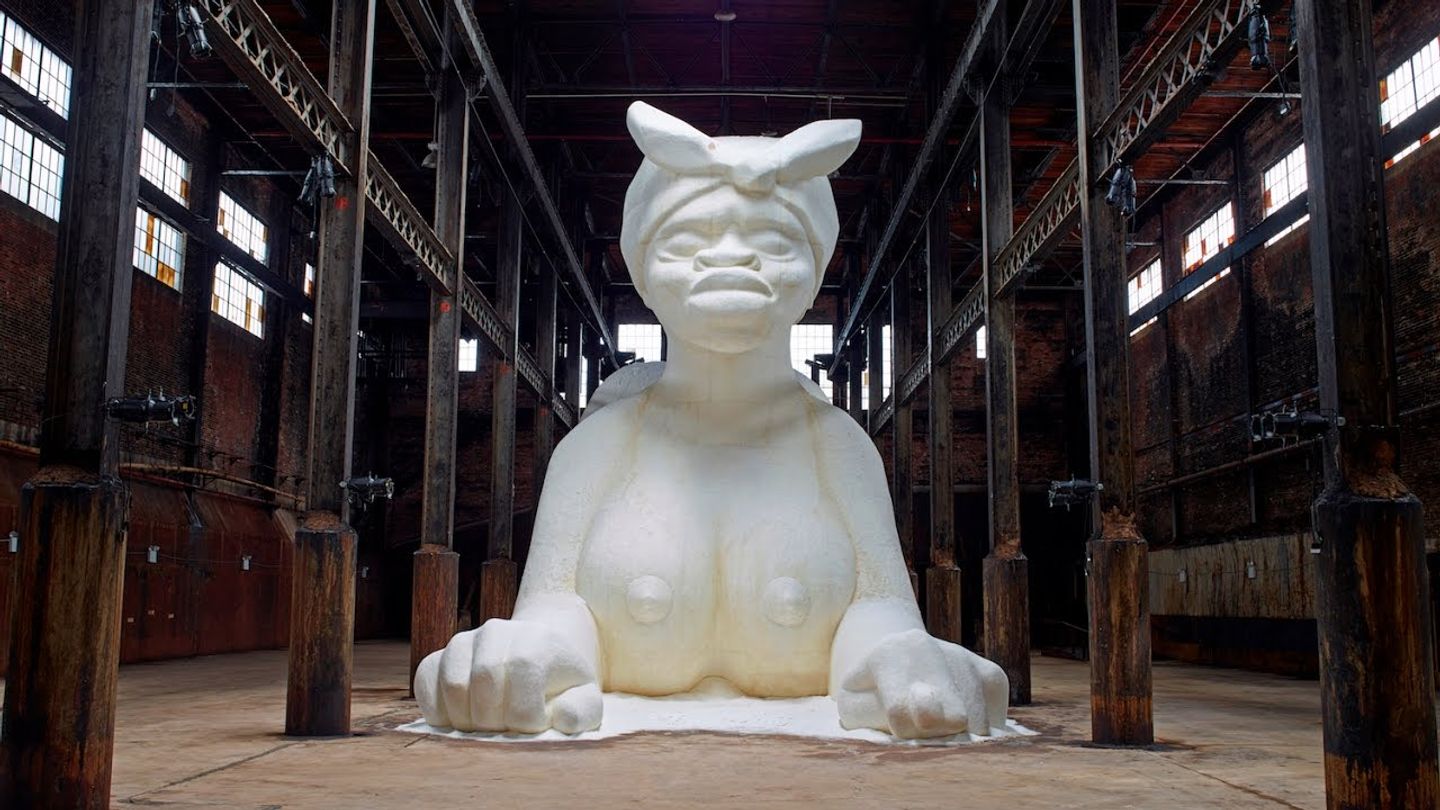
Under one of the vitrines of the Maryland Historical Society is displayed a selection of elegant, shiny silverware showing the refined taste of 1800s elites. Among the fine goblets, jugs, and service sets, however, sits a disturbing presence: a pair of rusted slave shackles. This is ‘Metalwork 1793–1880’, part of Fred Wilson's landmark 1992 exhibition, Mining the Museum, which rearranged and reinterpreted objects from the Society's collection. No explanation is offered, and none is needed. The juxtaposition operates a sharp correction of collective memory, reuniting extreme wealth with the forced labour that made it possible. Yet, refusing to be purely didactic, the work recalls histories within uncannily temporal entanglements, invoking ghostly presences that are simultaneously confrontational and ungraspable.
In reading curator KJ Abudu’s introduction to his exhibition ‘Living with Ghosts’, it becomes apparent that working with the spectral is critical to reflecting on the visible and invisible, the material and the immaterial of the legacies of historical colonialism, racial capitalism, plantation economies and phantomised epistemologies [1]. If we understand spectral apparitions as the emergence of unresolved trauma and incomplete projects of liberation, it is critical to tend to the ghosts of contemporary politics. These figures are both synchronic (rooted at one point in time) and diachronic (existing across a spectrum of time). Ghosts belong to a non-linear, complex understanding of time that, according to Achille Mbembe, defines the postcolonial condition [2]. Because of their mysterious nature, they are impossible to fully assimilate into an Enlightenment-based Modernist epistemological world. Beyond being mere metaphors, such spectres are sensitive presences of non-present phenomena; shapes used by Marxist theorist Jacques Derrida to unsettle the very theory of the knowledge of reality, coining the now-popular term ‘hauntology’ [3]—a combination of ‘ontology’, a branch of metaphysics dealing with the nature of being, and ‘haunting’. Hauntology suggests that it is crucial to attune to what is both dead and alive, past and future, speaking yet never fully understood.
In this sense, I argue that food constitutes a powerful ghostly material, in which the hyper-specific and the hyper-object [4], the familiar and the opaque, the pleasurable and the disturbing coexist in forever-entangled and emotionally resonant ways. Fred Wilson’s ‘Mining The Museum: Metalwork 1793-1880’ offers a perfect example of this through sugar and its colonial legacy. The dates in the title, for instance, track from the introduction of granulated sugar crystals to the US West Coast by sugar planter Étienne de Boré in 1795, to the turbulent 1870s and 80s following the abolition of slavery in the US. During this period, extractive colonial modes of production made sugar plantations the leading agricultural-ideological model of modernity. While rooted in historical records, however, the presence of a pair of shackles in the work does not solely function as “one that represents the many”. Nor is it a mere museological reflection on the systematic erasure of uncomfortable histories. Instead, the chains speak of an absence made concrete: a ghost that haunts us specifically because of its temporal vagueness and ungraspable delineation. Who did they bind? For what exact purpose? What histories remain unresolved?
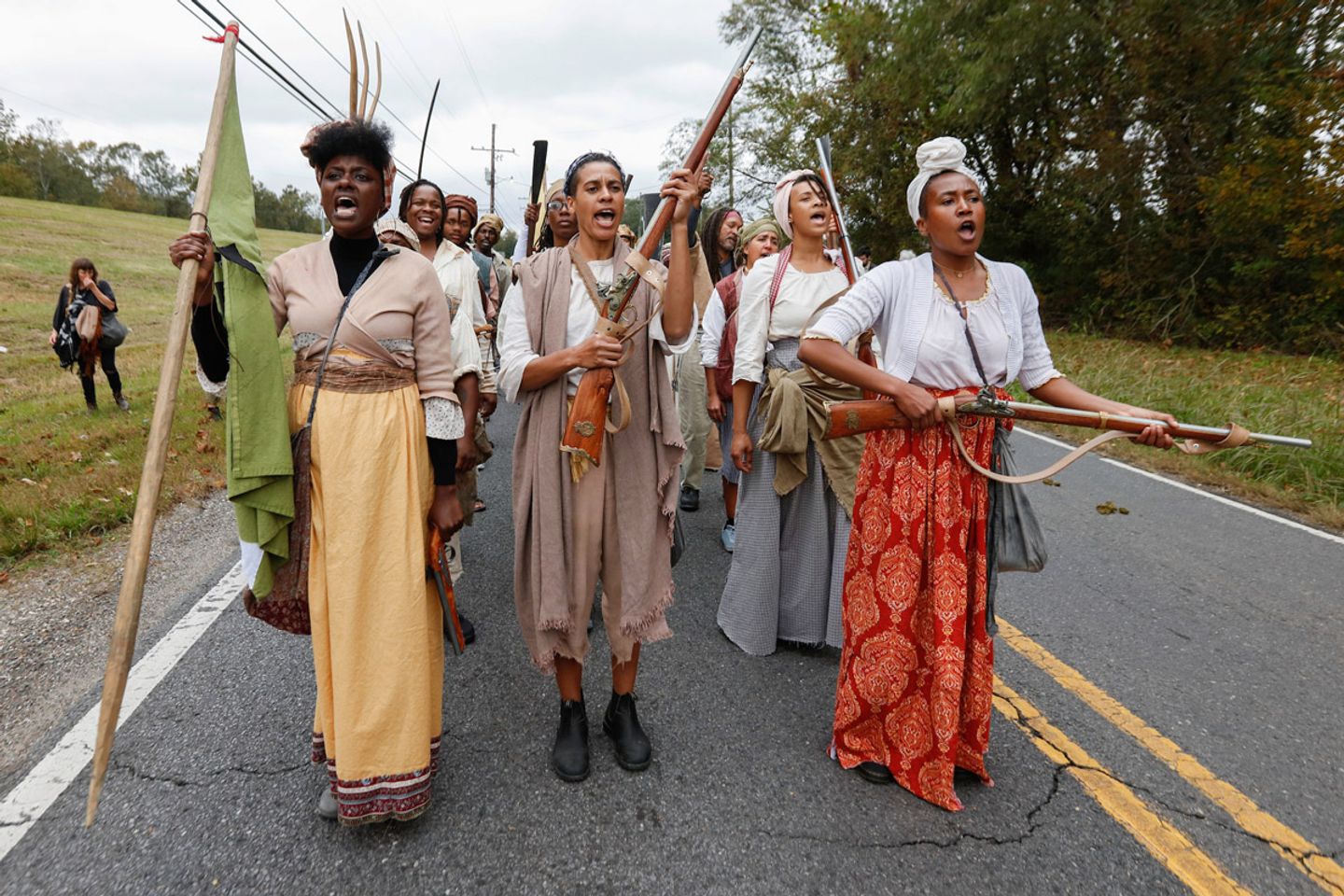
Taking a step forward, Dread Scott’s participatory performance ‘Slave Rebellion Reenactment’ makes a speculative (yet literal) return to the past on the very land that sought to erase it. The project involved hundreds of participants in period costume, retracing the path of the 1811 German Coast Uprising in Louisiana, an often-forgotten insurgence led by sugar plantation workers. The original revolt involved about 500 enslaved labourers who rebelled and joined a liberation army towards New Orleans, before being massacred by federal troops and local white militia. Scott’s work rejects the glorious framing of national narratives, instead focusing on a historically excluded liberation event and showing the mostly Black contemporary rioters the links between their current struggle and the original uprising. In fact, as the enactors were marching, the participants passed by petrol-extraction sites located on top of plantation lands, lower-class and discriminated neighbourhoods, and had to endure present-day racist commentary, demonstrating how the history of the sugar plantation is still very palpable two centuries later.
The ‘Slave Rebellion Reenactment’ exemplifies the idea that ghosts are charged with present potential and prompts what Avery F Gordon calls something-to-be-done. Borrowing from Marcuse’s idea of ‘historical alternatives’, she reclaims utopian imagination as a powerful energy which underpins the resistance of marginalised ways of living. To her, once these utopian ideas are suppressed, they are never fully erased, and they come back as haunting presences, pushing to reanimate the language, form, and fervour to present-day social struggle [5]. Hence, ghosts are as much for the dead and the missing as for the new emerging forms of what has not (yet) come to pass. Using the words of Sadeq Rahimi, “Ghosts represent the past, but they are not from the past.”[6]
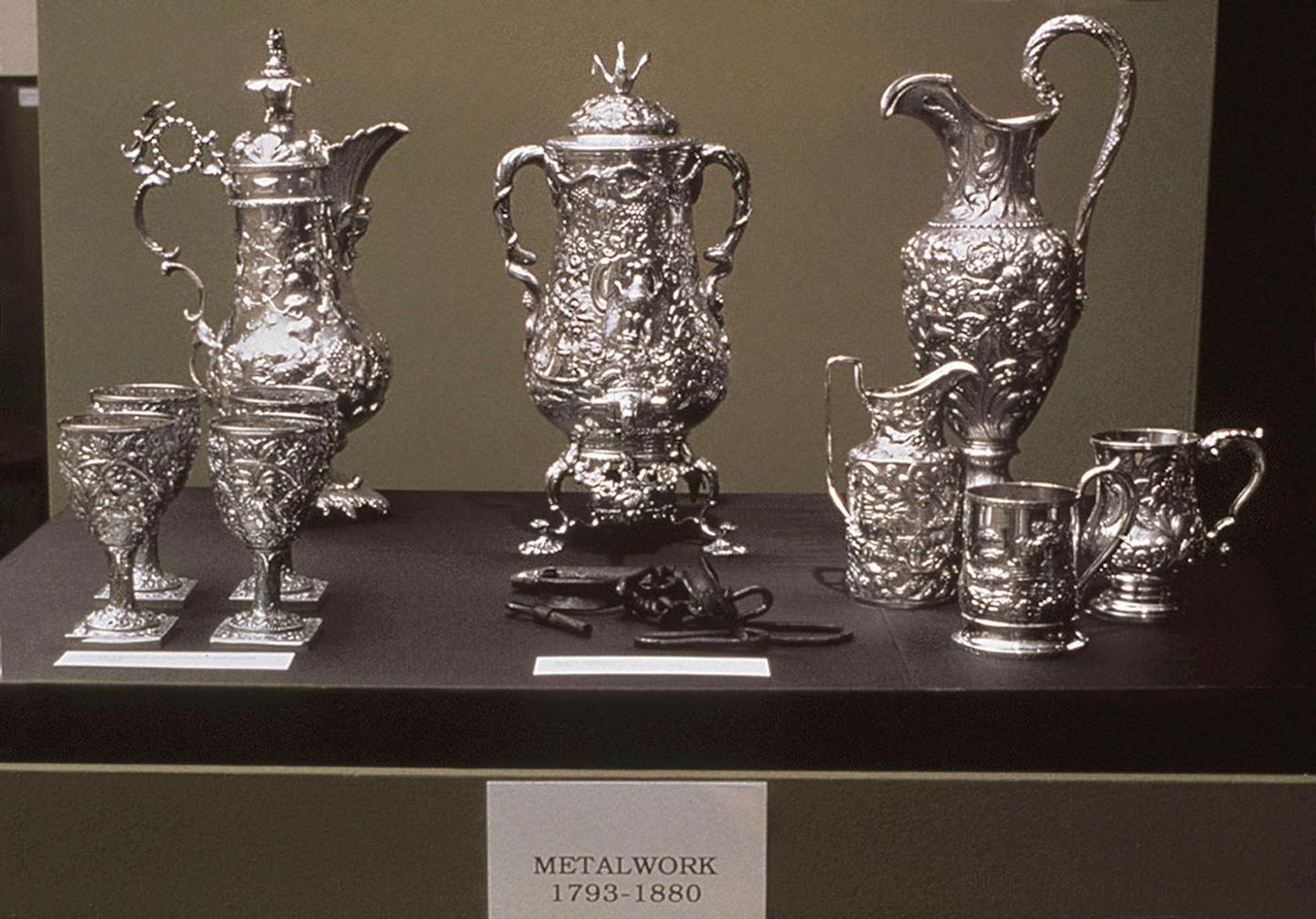
Enter Kara Walker’s monumental installation ‘A Subtlety, or the Marvelous Sugar Baby’ at the decaying Domino Sugar Factory in Brooklyn. The work features a towering, sphinx-like mummy figure whose distinctly caricatured Black features conflict with the bleached sugar material composing her skin (a literal display of ‘sugar coating’). The title ‘A Subtlety’, which refers to medieval sugar sculptures as decorative centrepieces for elite feasts, reveals a cacophony of references that trace the intertwined histories of gender violence, colonial power, and food-capitalist economies. The sphinx, an epitome of unresolved questions and haunting riddles, is a large grotesque monument that at once reminds us of the scale of the sugar industry and reproduces the facial traits of the ‘mammy’ stereotype—a US caricature used to create a narrative of Black mother-like women being content within the institution of slavery and domestic servitude. Such a figure is at times linked with the white supremacist sexual fantasies of black animality and lasciviousness. Once again, the spectres of violence are simultaneously confrontational and ungraspable. Kara Walker’s sphinx inhabits the complex intersection of economies, stories, fantasies and tensions coexisting in a non-linear time, full of unfinished, half-recorded, blurred entities.
These three examples of artworks from the US East Coast are, as is typical of post-colonial spectres, at once site- and historically specific, and stepping into a murky space and time continues. “Being haunted”, as Gordon suggests in ‘Ghostly Matters’, “draws us affectively, sometimes against our will and always a bit magically, into the structure of feeling of a reality we come to experience [...] as transformative recognition.”[7] In other words, these works reveal the objects (Wilson), actions (Scott), and creatures (Walker) of our food systems as phantasmic time discontinuities, reversals, inertias, and oscillations. Through them, we glimpse forces that, while not immediately apparent, still linger, call for action, and break through a sugar-coated dominant epistemology. Ghosts are present, and they are cooking.
References:
[1] KJ Abudu, 'Living With Ghosts: A Reader', 2022, p. 5.
[2] Achille Mbembe, 'On The Postcolony', 1996-2002, pp. 1–18.
[3] Jacques Derrida, 'Specters of Marx', 1994
[4] Timothy Morton, 'Hyperobjects: Philosophy and Ecology after the End of the World', 2013
[5] Avery F Gordon, Katherine Hite and Daniela Jara, 'Haunting and thinking from the Utopian margins: Conversation with Avery Gordon' (in Memory Studies 2020, Vol. 13(3), Special Issue: Ghosts, Exhumations and Unwieldy Pasts, eds. Katherine Hite and Daniela Jara) 2020, 337–346
[6] Sadeq Rahimi, 'A Hauntology For Everyday Life', 2021, p. 5
[7] Avery F Gordon, 'Ghostly Matters: Haunting and the Sociological Imagination', 1997-2008 p. 8
—
Images:
[1] Fred Wilson, ‘Metalwork 1793-1880’ (1992) from Mining the Museum, at Maryland Historical Society. Photo by Ken Schles and Jeff Goldman
[2] Dread Scott, ‘Slave Rebellion Reenactment’ (2019). Photo by Soul Brother.
[3] Kara E. Walker, ‘A Subtlety’, or the ‘Marvelous Sugar Baby’ (2014) at Domino Sugar Refinery. Photo by Jason Wyche.
—
This essay is the second edition of “Sugar’s Unfinished Business: the hauntology of food systems in contemporary art”, originally published for Boca Aberta, a book by PARALAXE (2025). Haunting histories of sugar, bananas and chocolate are further explored by Kevin Bellò in “Bittersweet Cartographies: how contemporary artists navigate postcolonial narratives through chocolate, sugar and bananas”, a lecture that is part of Food Art Histories, available as part of the AltMA.
Kevin is an Italian curator and researcher investigating edible knowledge, politics, and inter-species collaborations. He is co-founder of the pan-European art collective The Sympoietic Society to explore environmental activism, practices of co-creation, and healing through storytelling. Their curatorial approach moves from food to investigating ecological and political super-structures, promoting cognitive justice and developing practices of care.