When I was younger, my grandmother used to encourage my cousins, sister and I to pee in the vegetable garden. We children would giggle, flushed with mischief, but she was serious. “You are watering the kiwis,” she’d say, brushing her hands on the multipurpose apron where she kept all the objects in the world. That soil beneath the kiwi tree was so fertile that even the stems of flowers she’d stolen and propagated there would sprout alongside random windblown seeds, as if they had finally found their way home.
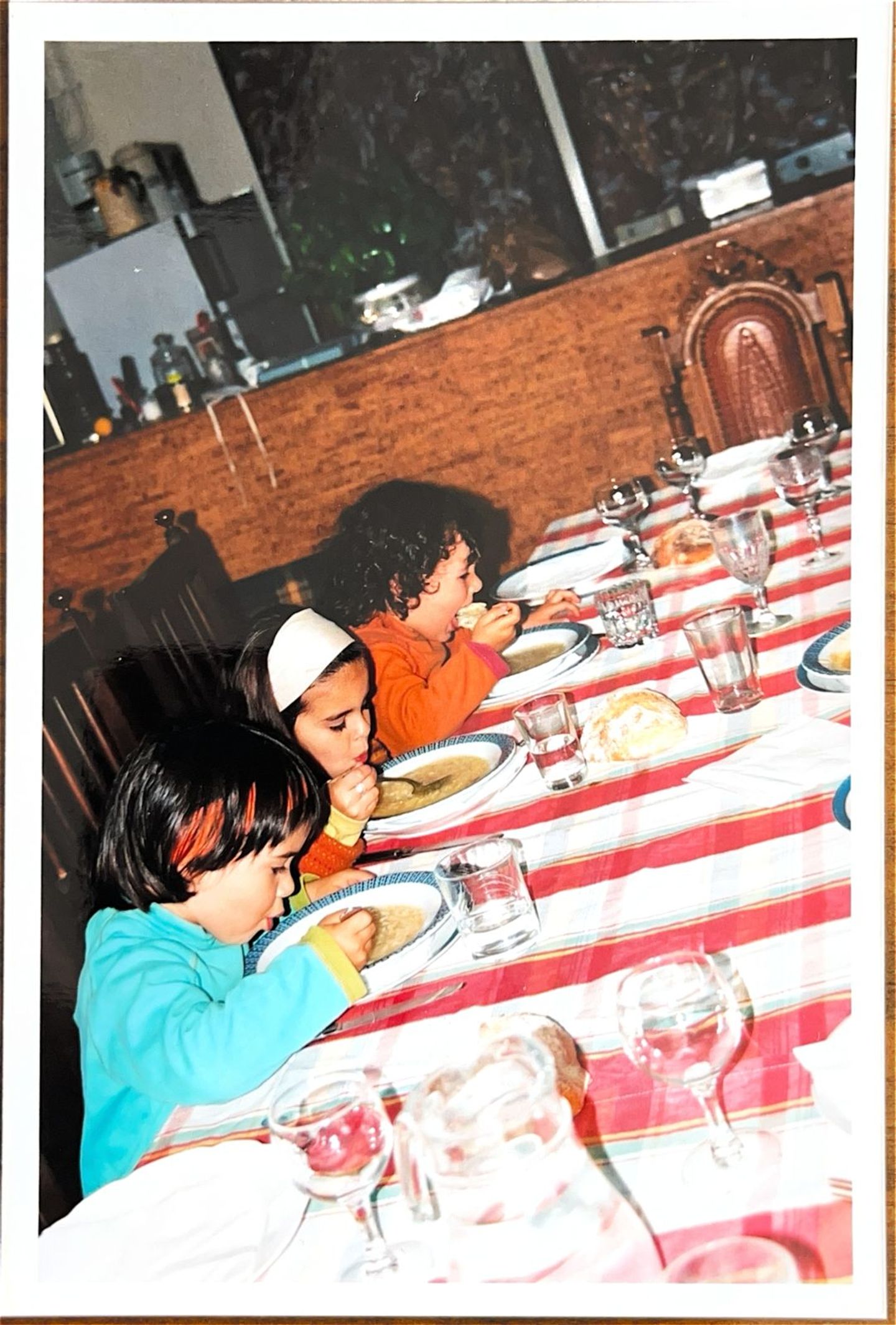
Our warm bodies became part of the land’s nourishment, closing the circuit of intake and return. We ate from the garden and gave back to it, the idea of eating vegetables watered by our own pee never deterring us from our daily soups. Many other plants also populated the garden in a cacophony of colours, scents, and functions. We ran to find four-leafed clovers, played among the apple-mint, avoided stinging nettles, and waved to the mugwort from afar.
Intimate ties existed between our bodies and the land: urine nourished the vegetables, leftovers fed the chicken, and, in turn, their waste enriched the soil. Grandma knew how to heal nettle stings with mallow and bee stings with plantago. Chamomile tea was the fix for nearly everything. In her house, we played barefoot until exhaustion. We’d make dirt and carrot soups, pod broad beans in exchange for stories and wash underwear and tea towels in the same water of the stone washing trough. By mid-afternoon we’d be fast asleep, faces flushed, dreams pending. The liminal spaces between clean and contaminated, real and magical, awake and asleep, and skin and soil were lived with intensity and joy.
There was no clear line between domestic and cosmic. Any household chore could be a chant to the Big Mother. Plants were kin to eat and to heal, their knowledge carried in gossip, tales, songs. Who knows if urine really helped the plants? But grandma said so, and we followed. We were raised to be magical: tender, embodied, intuitive, attuned. To find kinship in raspberry bushes, to trust that carrots would communicate when they were ready for harvest. All of it could be true, no scientific proof required. My grandma never called her work witchcraft, but there was everyday magic in her hands. She was a green-thumbed woman, a moon-follower, a lover of homegrown teas and enchanted tales, a clever educator to seven children and ten grandchildren.
On Carnival, she would say that she was dressed up as a ‘normal person’, and that on all other days, she wore her real costume as a witch. I always suspected it was not a joke, for witchcraft is not only about brooms and cauldrons, even though every weekend she’d cook meals for thirty in a pot just as big. Witchcraft is a practice of wisdom and care: being a companion to plants and knowing all the tricks for interspecies cohabitation. As much as the broom can be a cleaning tool, an educational agent, and a tool for a potential flight, witchery is a daily practice of tending to others, allowing for dreams, and taking an active part in the systems of living and dying.
For centuries, elders across Europe just like her - healers, midwives, herbalists - were persecuted for their wisdom. The witch hunts of the Early Modern period were a deliberate dismantling of community-based knowledge and land-connected care. Knowledge that had until then been passed from grandmother to granddaughter was reframed as demonic. The ability to listen to plants; to know when to harvest or which herbs to mix was recast as heresy and punished in the most horrific ways. From the witch hunts, a capitalist economy emerged, as Silvia Federici writes in Caliban and the Witch (2004): ‘The battle against magic has always accompanied the development of capitalism, to this very day. Magic is premised on the belief that the world is animated, unpredictable, and that there is a force in all things…’
Today, the fight against women’s knowledge, reproductive rights, and independence persists as a stubborn shadow of that past, through far-right policies and propaganda. The repression draws us further from the land, from more-than-humans as family, and from magical thinking as a methodology for alternative world-building. Witchcraft is urgent in times of isolation, when we have little access to our ancestry. While my childhood was driven by magic and dreams, I soon learned in school that I must wash the cherry tomatoes before popping them in my mouth, that plants do not actually talk back, that knowing when to sow the cabbages according to the ‘feeling of the moon’ is not relevant or accurate, and that peeing in the garden is definitely not acceptable.
I grew separated from the fertility of the soil, unlearning how to belong in the process of becoming, and distancing myself from the mysteries of not knowing but trusting. I was stripped of my grandmother’s magic and thrown into a world where ‘time equals money.’ Here, witchery was a ridiculous play for lunatics and outcasts, rather than a daily practice of living within an ecosystem.
I go back to her garden—the place where I belong—in my dreams, especially now that she has passed away. I dream of making witchcraft and reviving the garden. And in these dreams, I recall a specific place that we kids called ‘the pit’. It was just behind the raspberry bushes, a deep cut in the ground where our dirty water, both human and animal, would flow. At the time, it seemed a million metres down. In my dreams, just beyond its edge, the groups of Artemisia vulgaris (Mugwort, or ‘Erva-de-São-João’ in Portuguese) wave at me. As kids, we would not dare go down into the ditch, so my relationship with this place and this plant was always one of distance and reluctance.
We never touched the mugwort, the plant which she behaves like a witch herself: growing in the margins and forgotten plots, a companion to dreamers, magical beings, walkers between worlds. Burnt as incense, drunk as tea, or laid beneath a pillow, it is used to sharpen the senses of the dreaming body. To open the third eye. To loosen the knots of rational thought and make space for something else… Worlding? Kinning? It has survived through centuries of erasure, growing wild where it is not wanted. Enduring. It speaks in a language of persistence and possibility.
My grandmother never cut Mugwort for her oneiric capabilities. None of us needed it; we dreamed so much all by ourselves. Now, however, I need it the most. To remember to be a witch, as connected to the land as a cabbage to the moon, kin to the soil. I keep her under my pillow, and in my dreams, Artemisia vulgaris is also our grandmother, who lets us run free and pee in the cabbage field.
Inês is an artist and researcher based in Porto. Thinking mainly through sculpture and food-making, she identifies the kitchen table as a multi-layered topos for reflecting upon shared traditions, identities and emotions, while thinking about the simultaneous acts of eating and being eaten as forms of care. Between crockery and tablecloths, her visual poems open discussions on local foodscapes, overlooked ecosystems and opportunities for interspecies symbiosis in a shared world.