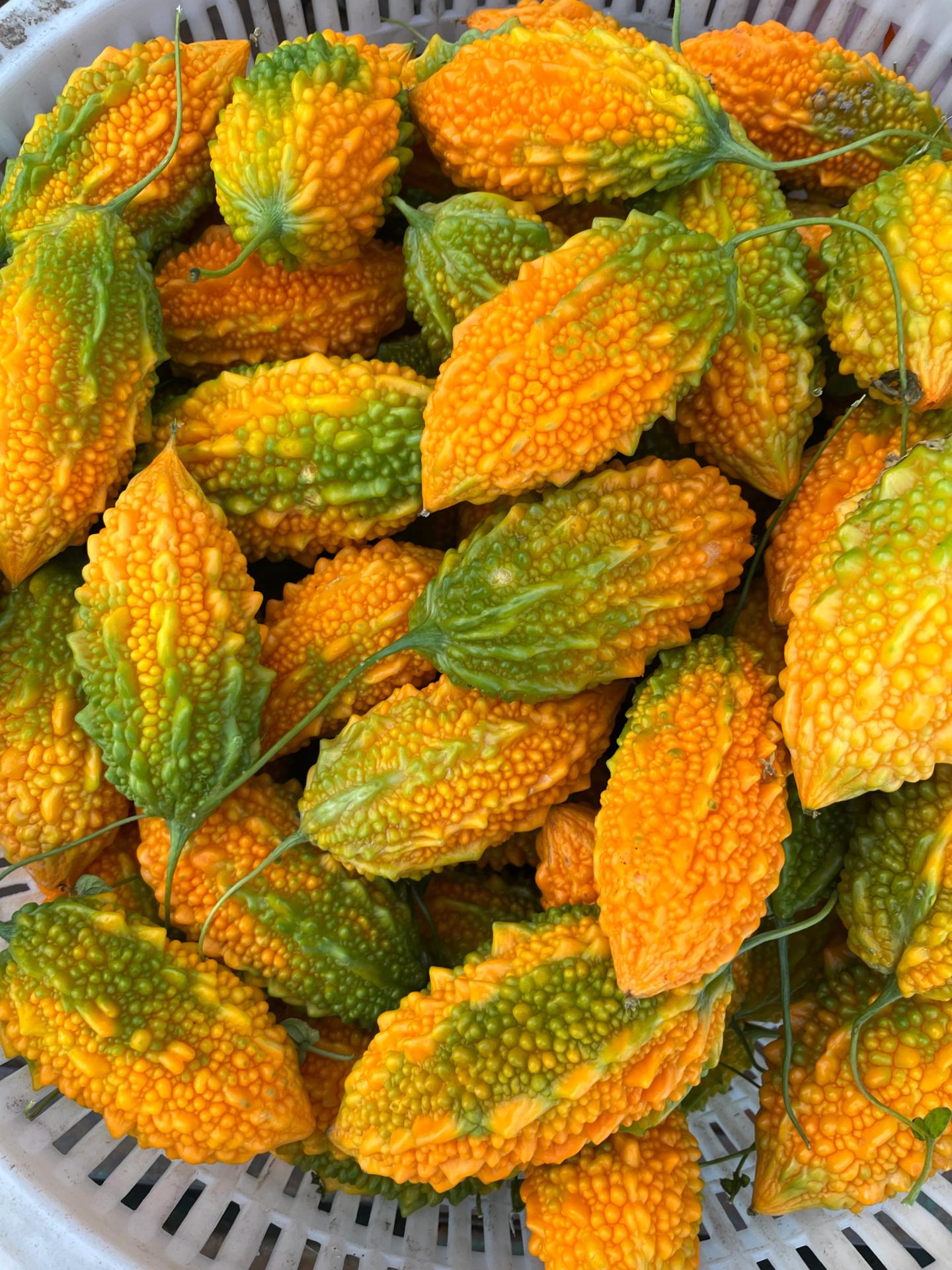
In the summer album on my phone, there is a photograph of a piece of fruit. Orangey-yellow skin, mottled with traces of green, not yet fully ripe. It has a knobbly surface, ridged with dorsal-fin-like protrusions. Though they are soft, not sharp, the fruit appears to be straining to bare its teeth, like a huddle of baby dinosaurs huddled together in a damp prehistoric rainforest.
The photo was taken in the parking lot of a seaside restaurant near my hometown. It was six in the evening, and relatives arrived from all corners of the city to celebrate a long-awaited reunion. The middle-aged generation bustled about, each assigning themselves the task of supporting the elderly. In so many cartoons, old people often appear puffy from years of sitting still, with layers of belly like a freshly baked soufflé. But aging in real life is more like drying fruit: day by day, one only becomes smaller, more fragile, more shriveled.
Taking advantage of the chaos, I began to look around and noticed a fruit vendor standing alone on the unavoidable path leading to the restaurant. I had always imagined fruit sellers appearing at noon by the roadside, or at the gates of tourist attractions, not in a restaurant parking lot at dinnertime. But my hometown is like a game map where magical food items can drop at random. They seem to detect my position with uncanny precision, landing squarely before me; whether as a reward or a punishment, I never know.
I couldn’t remember the name of the fruit in the photo, so I sent it to my father. Not because I expected an answer from him, but because I knew he was with my grandmother, and my grandmother knows everything.
A while later, the reply came: “Lixi Gua. It’s a type of bitter gourd.”
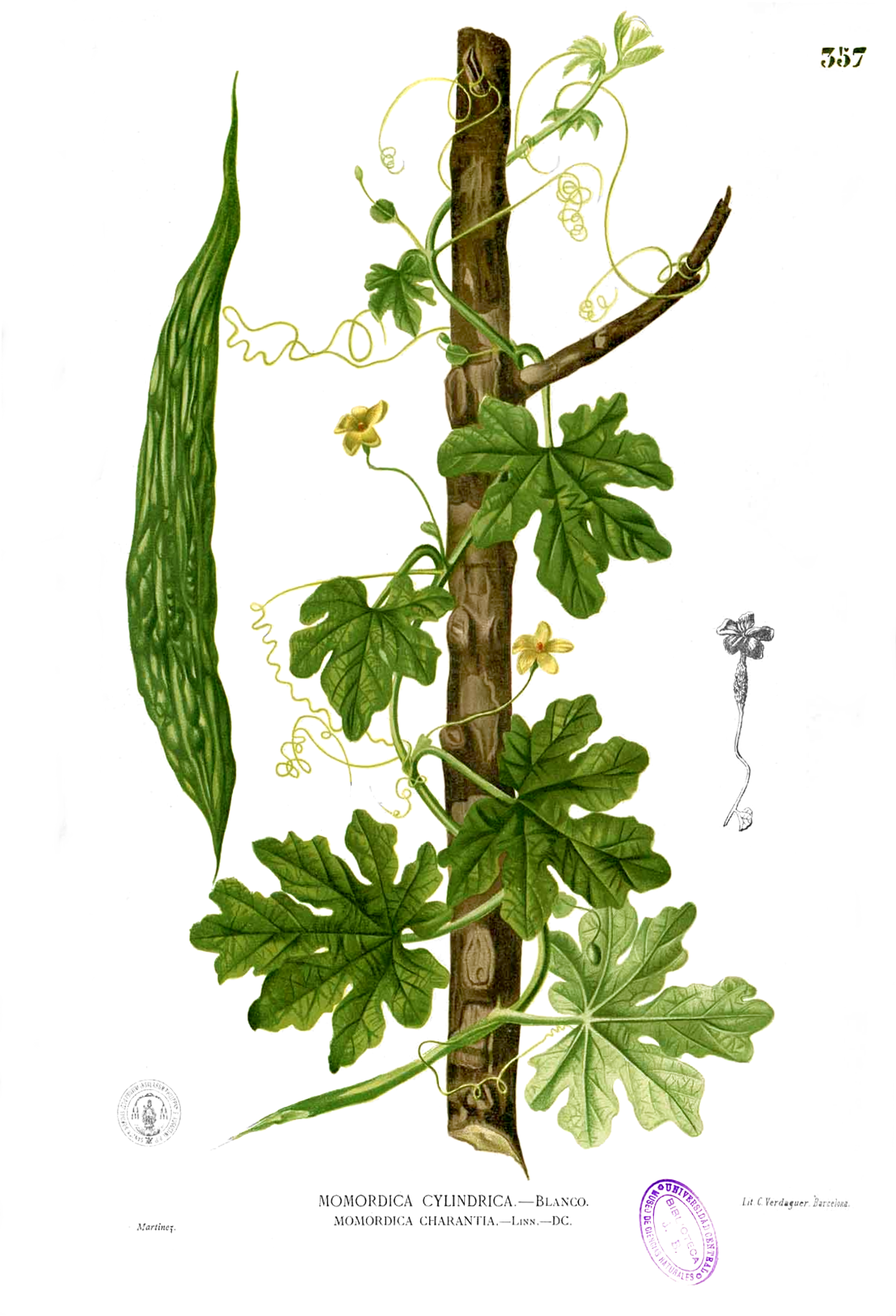
Bitter gourd is a common vegetable in China, well-suited to small-scale farming, the typical variety being long and pale green. You scoop out the pith, slice the flesh, and stir-fry it with fermented black beans to yield a crisp bitterness. These squat, plump, yellow fruits, however, are nicknamed ‘leper grapes,’ and when placed beside ordinary bitter gourds, they look like the characters in the 1995 Chinese cartoon ‘Big-Headed Kid and Small-Headed Father.’ They are said to be extremely easy to grow. During times when fruit was scarce, farmers often planted them as snacks for children.
As the group bustled, I drifted away from them to photograph the Lixi Gua. Ahead, my grandfather doddered his way toward the restaurant steps as if there was nothing he would care about. Behind me, my grandmother said, “Do you want some, sweetheart? Grandma will buy it for you.”
And just like that, I acquired my first ever bag of Lixi Gua.
The next day, I watched my aunt deftly break one open. Inside, its vivid red pulp enveloped the seeds, saturated with the kind of tropical flamboyance that borders on cliché. This, I was told, was a fully ripe Lixi Gua. Apparently some people refuse to eat it, simply because it looks too bloody.
Grandma said you have to purse the lips and suck, letting the red seed coating dissolve in the mouth before spitting out the seed. I did as instructed, feeling like a toothless little fish grazing on slippery, sweet seaweed. The sweetness seemed directly proportional to how much effort you put into sucking.
“Is it good, sweetheart?” Grandma sat beside me, smiling. I nodded.
If my hometown is a game about curious food, then my grandmother is undoubtedly the wizard who guides you through it. Unlike my taciturn grandfather, who immerses himself in his hobbies and appears only at mealtimes, my grandmother is always by the dining table when someone is seated there. In that empty, silent country house, only that table seems capable of briefly gathering the family, long enough for a few words to be exchanged. At such moments, fond of conversation as she is, my grandmother always worries a little too much. That someone might not enjoy the food; or enjoy it too much and suffer indigestion.
I sometimes feel that my grandmother’s day is divided into three acts by the meals. With long stretches of waiting in between, she is caught in an infinite loop anchored by the dining table. Those curious foods that, by chance or mistake, make their way onto the table may be a cruel kind of bonus, by gathering people in a way that will always end shortly after. As the only person in the family who recognises almost every local ingredient, when she names the curious foods we bring home, or reaches into her wallet to satisfy my curiosity to buy yet another; these are perhaps the brightest moments still available to her.
Maybe the fruit vendor sensed all this, and that was why Lixi Gua (and all other curious foods) appeared there at that precise moment in the game map of my hometown, so that I could encounter it, and unlock another encounter with my grandmother.
This article is a contribution from one of the participants of The Gramounce Food & Art Alternative MA 2025-27. Their writing is inspired by one of our seminars, or responds to a similar field of interest within food & art.
Ziyi Lian is a researcher, social designer, and writer moving between China and the Netherlands. Trained in Social Design at Design Academy Eindhoven, her practice drifts across food, space, community, and the textures of everyday life. She observes, chews on what she encounters, spits it out, and slips back into the crowd. She is also the co-initiator of To Be Cooked, a design collective exploring food as a medium of connection.