By Roo Dhissou and Frederick Hubble
This text was written by two researchers, each of whom work in what one would often assume were disparate fields. Roo Dhissou is a doctoral researcher and artist interested in community engagement and food, craft, architecture and installation. Frederick Hubble is a doctoral researcher and artist interested in seasonality, ritual, storytelling and gardening. Together, we endeavour to show how climate justice and community are inseparably linked.
In this text, we seek to think about community and the climate on a local and global level. As such, it is important to define what we mean by ‘climate justice’ and ‘community’. The concept of ‘climate justice’ refers to the equitable division of the burdens of climate change and the responsibilities of its mitigation. When we refer to the term ‘community’ in text, we want you to speculate who your communities are. What do they look like, and where do they live? What gives them a sense of proximity to one another, be that lived experiences or characteristics? In this context, that group of people—your community—share interests, goals and support one another. They belong to a certain neighbourhood, town, demographic, social group and heritage. This is what we mean by community.
Expanding out from our immediate communities, we see their direct connection to climate justice as paving the path to an ecological civilisation. The first step on this path is reclaiming the commons. We mean ‘commons’ in its literal sense of that which belongs to all of us; as well as our home, the Earth, and the commons of the Earth family, of which we are a part. Through reclaiming these commons, we can begin imagining a common future, and thereby sow the seeds of abundance through the act of “commoning.”(1)
Communal, local and shared knowledges exist within communities across urban and rural spaces. In this text, we widely address communities who adopt seasonality in their food and growing practices. From foraging networks, allotment gardeners and home growers, to farmers, city dwellers, and creatives. Yet, it is imperative to note that, while these knowledges exist, they have not always come easy to all demographics. It is widely recognised that the communities who bear the brunt of climate change are in the Global South, or those disproportionally affected by poverty and systemic injustice. Whether physically, by flooding, desertification, water scarcity or increasing storms, or politically, through conflict or racially influenced immigration policies; those who've done the least to cause climate breakdown are often the ones who suffer its effects the worst.
Despite being central to our argument; it is not up to individual communities to implement strategies and infrastructure to mitigate the effects of anthropogenic climate change. It is vital to ensure governments and local authorities are held accountable. However, with their corrupt agendas and capitalist structures, change is often affected by local community through DIY, grassroots solutions.
It’s difficult to do justice to all these complex topics in the space of a single essay. Instead, this text focuses on 3 key areas of community resistance: the notion of ‘community fridges’; allotments and communal gardens; and foraging in cheffing and local communities.
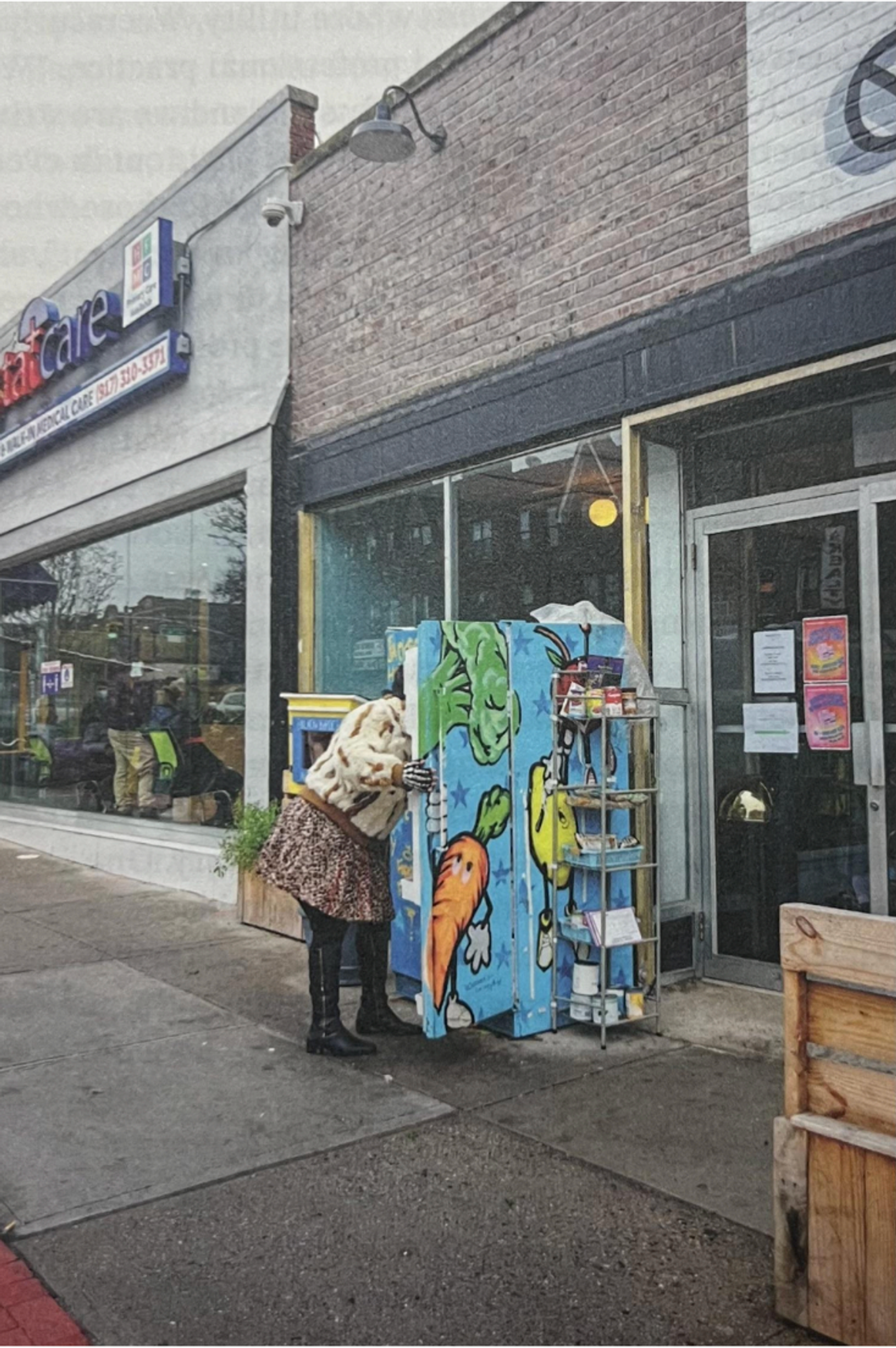
‘Community fridges’ are global mutual aid schemes steeped in traditional ideas of community. Yet in spite of this they represent a refreshing new way to think about what food infrastructure and climate justice looks like, and how it operates outside of the capitalist system(2). Community fridges repurpose surplus food from restaurants, cafes, local co-ops and community donations. These interventions are not only responsive to urgent needs, but adaptive to space limitations, and increased demand from charity organisations, food banks and non-profits. Also called ‘mutual aid fridges’, they work on a trust-based economy.
Sometimes they are supported by restaurants, whose support can help pay any fines for the use of public space. Others are run purely by volunteer groups. They function on the understanding that anyone using them considers themselves to be part of a wider eco-system and community through which many others can be supported; they feed each other. With their shared incentive to eliminate food waste, community fridges simultaneously address food surplus and sustainability, and bring the community together through radical acts of care.
Allotments and communal gardens are another example of spaces maintained by communities, whose work seeks to reduce the effects of the climate crisis on a local level. By growing locally, allotment and community garden users are taught seasonality. Further to that, having a community network facilitated by communal allotments can allow the sharing of knowledge. Not only do they provide seasonal sustenance, allotments can also allow for much needed respite from busy cities, facilitating recreation, grounding and nurturing that allow connection with the soil and the more than human.
However, contrary to the communal and environmental benefit of allotment spaces and open access gardens, they remain under threat from authorities whose primary interest is that of capital. In post-pandemic UK, council rent hikes and high fees make allotment growing into a socio-economic hierarchy(3), with only those able to afford higher costs able to grow their own produce.
This prompts us to ask the question: Who gets to grow? Prior to their resurgence in popularity during the pandemic, these spaces provided a sustainable food source for those otherwise unable to afford it. Now, many have become recreational hobby spaces for the white middle class citizens of the UK, rather than providing practical solutions to issues in food distribution, and a space for community to those with little access to green space.
This issue of access extends to foraging in both cheffing and local communities. “Although the act of foraging has been present for centuries, there has been a resurgence of foraging in recent decades as a means of accessing nutritious and free foods. However, the space is largely dominated by wealthy, mostly white, individuals and high-end restaurants selling foraged food.”(4) Foraging, despite its recent resurgence in popularity, is becoming an ethical and community issue. Here, capitalism again rears its ugly head, through those coining terms such as “re-wilding”, so called “sustainable” foraging, and “wild” food. They deny countless generations’ worth of knowledge that honours the land beyond human existence. Terms like these reinforce the colonial division of human and land, human and animal, and human and the wild. In this sense, for us to truly forage sustainably, we must acknowledge diverse indigenous communities globally for whom this is more than just a resurgence, and instead a way of life.
On this global scale communities of the Global South disproportionately suffer the brunt of the climate crisis through food depletion, the encroachment of crop monocultures on their traditional forms of sustenance, and increasing weather disasters. These communities are denied access to the food they have historically grown themselves, and are instead forced to consume cheap supermarket foods that are shipped across the world.(5) In the West, this not only perpetuates a systemic injustice toward monitory living here who come from the Global South, but also maintains existing inequitable labour conditions for those growing the West’s produce, who are disproportionally based in the Global South. Whether in the West or Global South: food, growing and farming continue being used to control populations.
In this short provocation we have prompted questions such as who gets access to food? Who gets to grow? And whose knowledge was it anyway? The three examples shared above are minutiae of a larger system of control, power and capital. The social concepts of food sharing, communal land, and collective knowledge are systems that have existed globally for millennia. And, though they’re not as omnipresent in Western cultures, they continue to be practiced among communities of the Global South.
They serve as a prescient reminder of the continued importance in fostering an ethics of community and collective practice in the face of the climate crisis. Even as capitalist governments and right-wing authorities continue dividing communities and social groups; the collective approach centres the needs of minority groups, those affected by poverty, and working class communities. Whilst it requires governmental and judicial infrastructure to mitigate the impacts of anthropogenic climate change. These issues also require a collective, community-driven approach to develop multitudes of localised solutions for communities. An approach which should span borders and ethnicities to create collective action on a global scale. Climate justice is community justice.
___
(1) Shiva, Vandana. “Reclaiming Our Common Home.” Yes! Magazine, April 19, 2021
(2)Tavengwa, Tau, and Vyjayanthi Rao. Multiplicity: Exposição, 6a Trienal de Arquitectura de Lisboa, Lisboa, Portugal, 20 de setembro a 5 de dezembro de 2022. Porto, Portugal: Circo de Ideias, 2022. p121
(3) Marsh, Sarah. “Losing the Plot: Fears Huge Rent Rises Will Price Many out of UK Allotments.” The Guardian, April 21, 2023. https://www.theguardian.com/business/2023/apr/21/uk-allotments-rent-hikes-400-per-cent-councils.
(4)Abbas, Hadeel. “Decolonizing Foraging: Amplifying Black & Indigenous Knowledge.” Medium, 5 May, 2022. https://faithfullysustainable.medium.com/decolonizing-foraging-amplifying-black-indigenous-knowledge-69c86f72817a. Accessed on 11 Sep, 2023.
(5)Ghosh, Amitav. The nutmeg’s curse: Parables for a planet in crisis. London: John Murray (Publishers), 2021.
Roo Dhissou is a multifaceted artist, researcher, publisher, writer, and PhD candidate whose practice spans sculpture, installation, moving image, craft, and community engaged collaboration. Rooted in care, cultural context, and integrity, her work challenges dominant narratives and reflects deeply on disability, lived experience, social, environmental and material justice. Through inner and outer practices, reflective processes, and ethical research, Roo values relationship-building and intuition, prioritising process over product to create thoughtful, impactful art.
Most recently, Roo Dhissou was awarded the Serpentine Galleries’ Support Structures for Support Structures fellowship in 2024, alongside five other UK-based artists; she was also selected for New Contemporaries 2024; and she was commissioned by the Victoria & Albert Museum to create a new installation for London Design Festival 2025.
Photo by Taran Wilkhu